Beliefs Influence Argumentative Writing
Beliefs Influence Argumentative Writing
May 8, 2023· ·
0 min read
·
0 min read
Liam W. Hart
Abstract
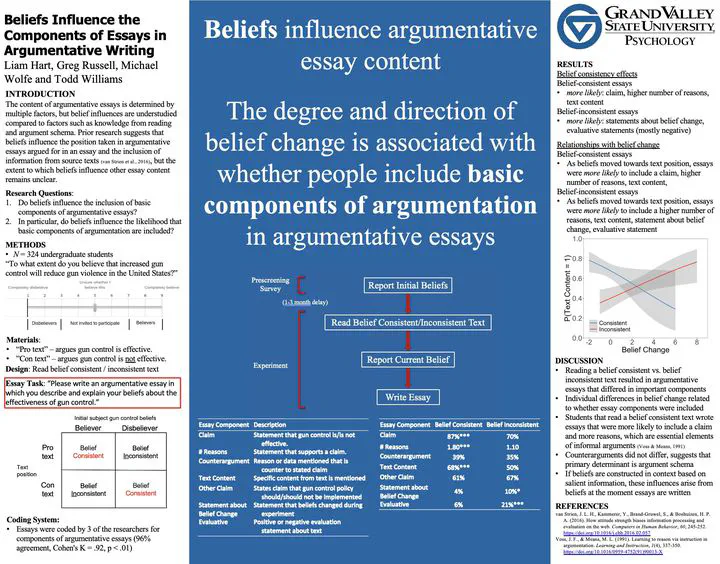
Individual differences in argument schema are a primary determinant of which basic components of argumentation are included in written arguments, but there has been little investigation into other factors at play. The present experiment investigated the influence of beliefs on the generation of written argument. Believers and disbelievers in gun control effectiveness read a one-sided text that was either consistent or inconsistent with their beliefs, then wrote a 250-word argumentative essay explaining their beliefs. Essays were coded for the presence or absence of a claim, number of reasons supporting the claim, and the presence or absence of a claim, counterargument, text content, policy claim, statement about belief change, and evaluative statement about the text. Supplementary subjects rated essays for position on the issue, consideration of both sides, type of support for claim, emotionality, and clarity. Belief-consistent subjects wrote essays that were one-sided but contained higher quality arguments than belief-inconsistent subjects’ essays. Additionally, several of these essay characteristics differed depending on the degree of belief change in response to reading the text. This study provides evidence that beliefs influence the inclusion of certain basic elements of argumentation in argumentative essays, and that the inclusion of these elements changes dynamically as beliefs change.
Date
May 8, 2023 12:00 AM
Event
Midwest Cognitive Science Conference
Location
Grand Rapids, MI
Grand Rapids, MI